

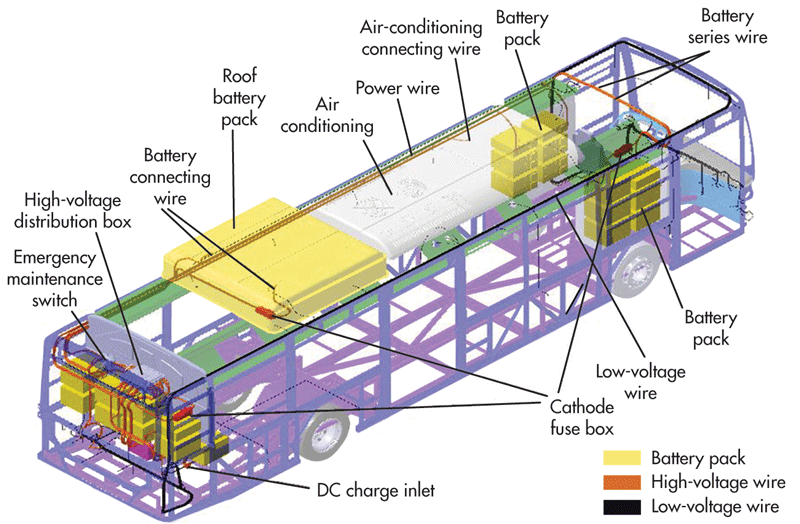
Executive Summary
The rapid transition to high-voltage (HV) electric bus platforms and passenger vehicles has created an urgent demand for a new class of “High-Voltage Systems Technicians.” As 800V DC architectures become the industry standard for 2025–2026, training programs must evolve. This paper outlines a comprehensive framework that shifts focus from traditional automotive mechanics to power electronics, battery chemistry, and advanced electrical safety protocols required to manage modern transit and passenger fleets safely and efficiently.
1. Core Technical Knowledge Modules
Module 1: EV Architecture and Power Electronics
Modern technicians must master the energy flow from the grid through the DC charger (up to 200kW) to the PMSM (Permanent Magnet Synchronous Motor).
- DC Link Capacitors: Technicians must understand that these stabilize DC bus voltage (typically 700–850V DC) depending on battery system voltage and filter ripple from the battery. Critical Safety Competency: Stored energy remains after shutdown. Training must emphasize that residual voltage can exceed 400V even after battery isolation, requiring mandatory timed discharge verification.
- The Shift to SiC (Silicon Carbide): While IGBTs remain common, the 2026 fleet heavily utilizes SiC MOSFETs. Technicians must understand that SiC allows for higher switching frequencies and lower energy losses. Diagnosing these requires high-bandwidth tools capable of analyzing 8–20 kHz switching environments.
- PWM and Field Oriented Control (FOC): Proficiency in Pulse Width Modulation (PWM) is required to diagnose how the inverter manages torque and speed. Technicians must be able to verify three-phase output integrity at the motor terminals.
Module 2: Advanced Battery Systems and BMS
Technicians must distinguish between different lithium-ion chemistries as they present unique risk profiles during service and salvage:
- LFP (Lithium Iron Phosphate): Increasingly used in 2024–2026 bus fleets due to higher thermal stability (runaway threshold ~250°C).
- NMC (Nickel Manganese Cobalt): Offers higher energy density but is more sensitive to thermal runaway (~150–200°C) due to oxygen release from the cathode.
- The Isolation Monitor (IMD): A core skill is diagnosing “first-fault” conditions where the BMS detects a leakage to the chassis before it becomes a lethal touch-voltage hazard.
2. Advanced Safety and Risk Mitigation
2.1 The Physics of Electrical Shock
Training must move beyond “don’t touch orange wires” to a physiological understanding of shock:
- AC Shock (50–60 Hz): Interferes with the heart’s natural rhythm; ventricular fibrillation is likely at low current levels (50–100 mA).
- DC Shock (800V Systems): In 800V systems, there is no “zero-crossing,” meaning electrical arcs do not self-extinguish as easily as AC. High-voltage DC causes sustained muscle contraction and severe internal burns, making the “let-go” threshold significantly lower in practical scenarios.
2.2 Arc Flash Risk Assessment (2025 OEM Data)
Training must include incident energy (IE) estimation. In 800V DC platforms with 5–10 kA potential fault current, incident energy can exceed 20 cal/cm².
- Hazardous Zones: Technicians must be trained to identify high-risk zones: battery junction boxes, DC-DC converters (800V to 24V), and HVAC compressor HV interfaces.
- PPE Requirements: Standard Category 2 PPE is often insufficient for 800V arcs. Training must specify the use of arc-rated face shields and Class 0 (1000V) or higher insulating gloves.
3. Practical Skill Requirements (On-Demand)
3.1 Grounding, Bonding, and Isolation Verification
The most critical defense against “touch voltage” is the integrity of the vehicle’s bonding system.
- Protective Earth Continuity: Technicians must verify resistance is less than 0.1 Ω between all conductive housings and the chassis.
- Insulation Resistance Testing: Using a Megohmmeter, technicians must confirm that insulation resistance exceeds 1 MΩ before re-energizing a repaired system.
3.2 Diagnostic Workflows and LOTO
- Live-Dead-Live Verification: This is the industry-standard protocol for confirming a system is de-energized.
- Manual Service Disconnect (MSD): Technicians must be proficient in the physical lockout/tagout (LOTO) of the MSD to ensure the battery pack is internally isolated before opening any HV enclosures.
- Specialized Tooling: Proficiency is required with CAT III 1500V or CAT IV 1000V TRMS wireless multimeters to allow for remote monitoring during high-risk testing.
3.3 Thermal Imaging for Preventative Maintenance
Using infrared cameras during high-load charging cycles is now a required skill. This allows technicians to identify high-resistance joints in charging receptacles or internal battery busbars before they trigger a thermal event.
4. Emergency Response: The Technician as First Responder
Technicians in the 2026 fleet must be trained in specific emergency protocols:
- Battery Smoke Events: Recognition of the “venting” phase and the “Detect, Evacuate, Isolate” protocol.
- Electrical Shock Protocol: Specific medical response steps for high-voltage DC exposure, which differs from standard industrial AC accidents.
- Color Coding & Labeling: Strict adherence to 2025 OEM labeling standards to ensure secondary systems (HVAC, Steering Pumps) are not mistaken for low-voltage components.
5. Conclusion: The Hierarchy of Controls
A competent 2026 training framework must instill a Hierarchy of Controls mindset:
- Eliminate: Use LOTO and MSD to remove energy.
- Engineer: Understand and maintain IMDs and capacitor discharge circuits.
- Administer: Follow energized work permits and restricted approach boundaries.
- Protect: Use Class 0 insulating gloves and arc-rated face shields as the final line of defense.